Pre-launchNVIDIA B300 — exploded view

BlackwellUltra.

Forty-eight of them, on bare metal. Online November 2026.

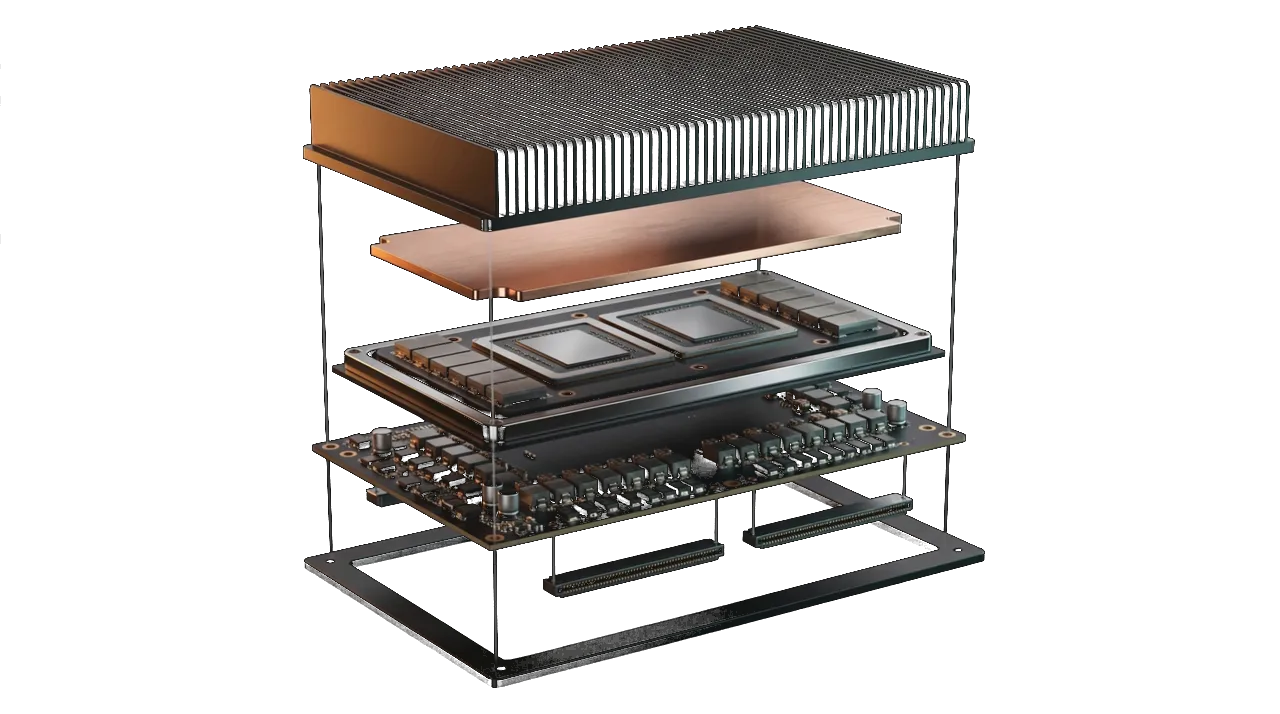
Exploded view of an NVIDIA B300 module: finned heatsink, copper cold plate, the Blackwell Ultra package with its HBM3e stacks, the power board and the mounting frame, floating apart in a stack.
  • HeatsinkAir-cooled, passive fins
  • Cold plateCopper, over the package
  • Blackwell Ultra packageTwo reticle-limited dies
  • HBM3e288 GB per GPU
  • Power stages~1,000–1,400 W configurable TDP
  • Board interfaceNVLink 5, 18 links, ~1.8 TB/s
  1. 01HeatsinkAir-cooled, passive fins
  2. 02Cold plateCopper, over the package
  3. 03Blackwell Ultra packageTwo reticle-limited dies
  4. 04HBM3e288 GB per GPU
  5. 05Power stages~1,000–1,400 W configurable TDP
  6. 06Board interfaceNVLink 5, 18 links, ~1.8 TB/s
Fig. 00 — one B300 module, illustrative render. Part names describe the drawing; the figures carry their sources.

Scroll to assemble

48 × NVIDIA B300 · Arkansas Ozarks · November 2026

B300 capacityin days,not months.

48 B300s, configured as six 8-GPU nodes. Bare metal. SSH and a scheduler. In a warehouse we own outright in the Arkansas Ozarks — american owned and operated, single tenant, with an operator on site. Online November 2026.

Time to capacity

HereDays
HyperscalerFour to ten weeks

Hyperscaler quoted lead time to provision reserved capacity.

Fleet
48 × B300
6 × 8-GPU nodes2 Sep 2026
Per node
2,304 GB
HBM3e, one NVLink domain3 Sep 2026
Support
On site
24/7, by the owners2 Sep 2026
Online
Nov 2026
target availability2 Sep 2026

Fig. 00 — the whole of it, building to die · Arkansas Ozarks

Chapter 01The site

A building we own, with nobody else in it.

Privately owned warehouse in the Arkansas Ozarks, owned outright. Not a cage in someone else's hall — no shared floor, no neighbouring tenant's contractors walking past your node, and no facilities company standing between us and the machines. American owned and operated, on American soil.

Region
Arkansas Ozarks
Building
Owned outright
Tenancy
Single tenant
Source
Our facility · 2 Sep 2026

Chapter 02On the other end

Someone is on site, at three in the morning.

The hardware is in a building we own and we are the people who run it. Call and you get an owner, not a ticket queue and not a first-line script. If the fix needs hands on the machine — reseat a card, swap a drive, power-cycle a node, put eyes on a rack at three in the morning — someone goes and does it. That is the whole advantage of a small fleet in a building you control.

Support
24/7 on-site technical support
Call
An owner answers
Hands
On the hardware
Source
Our facility · 2 Sep 2026

Chapter 03The fleet

Six nodes, one fleet, forty-eight devices.

48 B300s, configured as six 8-GPU nodes. Bare metal. SSH and a scheduler. No control plane between you and the device, no orchestration layer to learn. Root on the box, the driver stack, and a queue.

Fleet
48 × B300
Nodes
6 × 8-GPU
Access
Bare metal
Source
Our facility · 2 Sep 2026

Chapter 04One node

2,304 GB of HBM3e, one coherent domain.

An 8-GPU node holds 2,304 GB of HBM3e in one coherent NVLink domain. A model that needs tensor parallelism across several nodes today collapses onto one box. No cross-node collective in the critical path, no fabric to tune, no partition to reason about.

Per node
2,304 GB
Fabric
NVLink 5, 18 links
Per GPU
~1.8 TB/s
Source
NVIDIA GB300 NVL72 specifications · 3 Sep 2026

Chapter 05One device

288 GB on every device, ~8 TB/s to move it.

Sets the ceiling on how much model, KV cache, and activation state fits on a single device before you have to shard. Decode is memory-bound. Bandwidth, not FLOPS, is what governs tokens per second once weights are resident.

HBM3e
288 GB
Bandwidth
~8 TB/s
Dense FP4
~14–15 PFLOPS
Source
NVIDIA GB300 NVL72 specifications · 3 Sep 2026

Chapter 06Time to capacity

Nothing to procure. Days, not months.

Forty-eight GPUs, six nodes, one building we own. Nothing to procure, no queue ahead of you but the other reservations, and no regional capacity committee. Hyperscalers quote four to ten weeks to provision reserved capacity. We are working in days.

Here
Days
Hyperscaler
Four to ten weeks
Rate
On the call
Source
Our facility · 2 Sep 2026

Checked 2 September 2026 · every figure carries its source · 48 × B300 · quoted on the call · online November 2026

The lights come on

Now the paperwork.

Everything above is a specification. Everything below is a source, a date and a caveat. Checked against published figures, and stated so that it can be argued with.

Sheet
01of 07
Title
Pricing
Checked
2 Sep 2026
Scale
Not to scale

What the market actually charges

Published B300 rates, with the source and the date we read it on every row. Checked 2 September 2026.

The honest version

We are not the smallest number on the internet. $6.50–7.50 listings exist. The cheapest one we could confirm as in stock was $7.89, and that is the line we quote under.

Published rates · USD per GPU-hour

Datum = lowest bookable $7.89

Under the lowest rate we could confirm as bookable · Quoted on the call

  1. 01

    Neocloud listings, low end

    Unverified

    $6.50–7.50

    0.82×

  2. 02

    Lowest verified in-stock listing

    Verified

    $7.89

    datum

  3. 03

    Median on-demand

    Aggregate

    $7.85–7.87

    0.99×

  4. 04

    Oracle

    Rate card

    $15.00

    1.90×

  5. 05

    AWS on-demand

    Rate card

    $17.80

    2.3×

The datum is the lowest rate we could confirm as in stock, so multiples are against something a buyer could actually have bought. Hatched columns are published prices we could not confirm — including the one under the datum. The shaded region under the datum is where our own quote falls; it is a band and not a line because the figure depends on the job. Ranges are shown at their top value with the range hatched beneath. All rates read 2 Sep 2026.

Cheaper listings exist. Bookable ones mostly do not.

There are published B300 rates in the $6.50–6.95 range. We went looking for them. What we found was capacity that was out of stock, listings that could not be confirmed, or a sales process that never produced a slot you could actually take. The lowest rate we could verify as in stock was $7.89, and that is the number we hold ourselves against.

So the argument is not that some number of ours is the smallest on the internet. It is that the alternative you can actually buy today costs what the table below says it costs, it takes weeks to get, and we come in under it on a date you can hold us to. Every rate below carries where we got it and when we checked, which is not a courtesy — it is the only way you can tell the difference.

Our on-demand quote

Under the verified floor

We do not print a per-GPU-hour figure on this site. Capacity this small gets priced against the job — how many GPUs, for how long, on what term — and a headline number would be wrong for almost everyone who read it. What we will commit to in public is the position: our on-demand quote comes in under the lowest rate on this page that anyone could confirm was actually in stock, and committed terms price below that again.

Committed terms

1–5 year leases

Market range for 24–60 month commitments is $4.25–5.62. We are taking inquiries across that window. Longer terms price further below the on-demand quote. The figure is set against the job, on the call.

Leases — 1–5 years

The full table

Every rate, its verification status, the source URL, and the date we read it — with the methodology written out. Last checked 2 September 2026.

Open pricing

01.2 — Leases

We are taking inquiries on 1–5 year leases.

On-demand is quoted on the call. A lease is the other conversation: a named term, a named rate, and capacity that does not get re-priced when the market moves. One year is a lease. Five years is a lease. Anything in between is a lease. We quote it against the job rather than against a published ladder, because a two-GPU evaluation and four nodes for five years are not the same purchase.

Inquiries are open. A reservation is how one reaches us — put the term in the notes, or we will ask on the call.

An inquiry is not a signed term. Rate, start date and remedies are agreed on the call and written into the contract. Nothing on this page is a published lease rate.

Inquire about a lease
  • 01

    1 year

    A committed year. For a workload that is real and a horizon that is not yet.

  • 02

    2–3 years

    The term most buyers arrive with. Capacity and rate locked for the window you can actually plan in.

  • 03

    4–5 years

    The longest we will write today. For a team that wants the hardware in the building to stay theirs.

Sheet
02of 07
Title
Hardware
Checked
2 Sep 2026
Scale
Not to scale

One node, one memory domain

NVIDIA's published specification for the part, and what each number changes about the job you are trying to run.

We have not published benchmarks

The fleet is not online yet, so we have not run any. Every figure above is NVIDIA's published specification for the part, not a measurement of ours. When we have numbers from our own hardware, we will publish the methodology alongside them.

Per 8-GPU node · NVLink 5

2,304GB

HBM3e · 2.3 TB · one coherent NVLink domain

An 8-GPU node holds 2,304 GB of HBM3e in one coherent NVLink domain.

A model that needs tensor parallelism across several nodes today collapses onto one box. No cross-node collective in the critical path, no fabric to tune, no partition to reason about.

NVIDIA B300 · Blackwell Ultra · 288 GB per device · NVIDIA GB300 NVL72 specifications, 3 Sep 2026

288 GB288 GB288 GB288 GB288 GB288 GB288 GB288 GB2,304GB HBM3E28 LINKED PAIRS
Fig. 02 — one node in plan · 8 devices, all-to-all over NVLink 5Not to scale

02.1 — Per-GPU specification

NVIDIA B300 per-GPU specifications and what each figure changes about a workload.
SpecificationValueWhat it changes
HBM3e memory per GPU288GBSets the ceiling on how much model, KV cache, and activation state fits on a single device before you have to shard.
Memory bandwidth~8TB/sDecode is memory-bound. Bandwidth, not FLOPS, is what governs tokens per second once weights are resident.
Dense NVFP4 compute~14–15PFLOPSThe format the architecture is built around. Prefill and training throughput both scale with it.
NVLink bandwidth per GPU~1.8TB/sBidirectional, across 18 links. This is the number that decides whether tensor parallelism costs you anything.
Configurable TDP~1,000–1,400WConfigurable. We hold headroom at the top of the range rather than running the fleet at its limit.

A tilde means the figure is approximate at source. Where NVIDIA publishes a range, the range is what is printed — nothing here has been rounded or averaged.

02.2 — What it suits

  1. 01

    Large-model serving

    288 GB per device means weights, KV cache, and headroom coexist without paging. Batch until the memory runs out rather than until the shard boundary does.

    Rests on: HBM3e · Bandwidth

  2. 02

    Long-context inference

    KV cache is the whole problem at long sequence lengths, and it is a memory problem. Capacity per device is the lever, and bandwidth is what keeps decode moving once the cache is large.

    Rests on: HBM3e · Bandwidth

  3. 03

    NVFP4 training

    The architecture is built around dense FP4 at roughly 14–15 PFLOPS per GPU. If your stack already speaks NVFP4, this is the format it was designed for.

    Rests on: Dense FP4

  4. 04

    Tensor-parallel consolidation

    Eight GPUs, 2,304 GB, one coherent NVLink domain at roughly 1.8 TB/s per GPU across 18 NVLink 5 links. Multi-node tensor parallelism becomes intra-node.

    Rests on: NVLink 5 · HBM3e

02.3 — How you get at it

Bare metal. SSH and a scheduler.

Not a containerized cloud platform. There is no control plane between you and the device, no orchestration layer to learn, no abstraction deciding how your job gets placed. You get root on the box, the driver stack, and a scheduler to queue against. If you were planning to fight a platform to get at the hardware, there is nothing here to fight.

Not included

  • No managed notebooks or hosted IDE.
  • No object storage product. Bring your own, or use local NVMe.
  • No autoscaling. The fleet is forty-eight GPUs and the number is knowable.
Sheet
03of 07
Title
Operator
Checked
2 Sep 2026
Scale
Not to scale

Who runs this, and where it sits

Privately owned warehouse in the Arkansas Ozarks, owned outright. American owned and operated. 24/7 on-site technical support.

Not a cage in someone else's hall. Owned outright.

This is not a suite inside a colocation campus and it is not rented capacity in a hyperscale hall. It is a single building, in the country, with our hardware in it and nobody else's. There is no shared floor, no other tenant's technicians walking past your node, and no third-party facilities company between us and the machines. When something needs doing, the people who own the building do it.

The building is ours. There is no landlord taking a margin on every kilowatt and no rack rent priced off someone else's capital stack. That is the whole reason the quote is what it is — not a promotional price, not venture subsidy, just a cost structure most new entrants do not have.

Fleet
48 B300s, configured as six 8-GPU nodes.
Building
Privately owned warehouse, owned outright. Single tenant.
Access
Bare metal — SSH and a scheduler
Contract
Take-or-pay, 1–5 years
Facility sheet — the building and the service

Ownership and control

American owned, American operated.

A privately held American company, hardware on American soil, and staff who are the owners of both. The building, the machines and the people are all in the Arkansas Ozarks. Nothing about your workload is administered from outside the country, and no part of the operation is subcontracted to a facilities company or an overseas support desk.

Company
Privately held, American-owned. No outside operator and no foreign parent.
Hardware
Owned, not leased. Physically in the Arkansas Ozarks.
Staff
The owner-operators. There is no outsourced night shift and no offshore support tier.
Jurisdiction
United States, single tenant, single building.

Support

Someone on site, whenever it matters.

The hardware is in a building we own and we are the people who run it. Call and you get an owner, not a ticket queue and not a first-line script. If the fix needs hands on the machine — reseat a card, swap a drive, power-cycle a node, put eyes on a rack at three in the morning — someone goes and does it. That is the whole advantage of a small fleet in a building you control.

Phone
A number that reaches an operator, around the clock, for anything running.
On site
Physical access to the hardware at any hour. We hold the keys, so nobody has to be scheduled in.
Hands on
Reseats, swaps, reboots, cabling, console access. Whatever the machine needs, done by the people who built it.
Named contact
The person who scoped your job is the person you call. Not a rota, not a shared inbox.

What we will not do is publish a response-time guarantee before we have a single month of operating history behind it. Remedies and response expectations are written into your contract, where they are enforceable, and we will talk them through on the call rather than printing a number here that sounds good.

03.1 — Who we are

Owner-operators, not a platform.

Yottaify is the people who bought the building and ordered the hardware. Privately owned warehouse in the Arkansas Ozarks, owned outright, american owned and operated. When you reserve, the person who reads the request is the person who will scope your job and the person who will pick up when something breaks.

  1. 01

    Small, and knowable

    48 GPUs. Not "up to", not "100+". Every figure on this site is exact or carries a tilde, and every one carries its source.

  2. 02

    No landlord in the price

    What we can quote is what an owned building supports. It is not a promotional rate, and it does not depend on anyone's fundraising.

  3. 03

    Candour as a policy

    We say what we do not have — customers, operating history, certifications in hand — on the page, so it is never a surprise in a procurement review.

  4. 04

    A person, every step

    Receipt is automatic. Everything after it — position, call, term sheet, onboarding, 24/7 on-site technical support — is a named person, not a queue.

03.2 — The name

Why Yottaify

A yotta is 1024 — a septillion. It is a unit of enormous scale: the point where a number stops being something you can picture and starts being something you trust the notation for.

That is roughly the feeling of standing in front of a rack of B300s.

We named the company after a unit of scale because that is the product. Compute should not be a ceiling you plan around. It should be a number you turn up when the work demands it, and turn back down when it does not.

03.3 — Partnership

We would rather work with you than sell to you.

Yottaify is small, American, and owns its own infrastructure, which makes it useful to a certain kind of company: one that needs compute close to its own product and does not want a hyperscaler as a dependency. We are actively looking for a handful of technical partners to build alongside rather than a list of accounts to bill.

What that looks like in practice is negotiable and deliberately unstructured at this stage: capacity on terms that suit the work, early access before the general cohort, joint engineering time, and a direct line to the people running the machines. There is no partner tier, no programme document and no badge — there are six nodes and a conversation.

Start a partnership conversation

Goes to an owner, not a sales inbox.

  • Model and application teams

    Building something that needs large-memory nodes and would rather have a phone number than a support portal. Early access, real influence over how the fleet is configured.

  • Platform and tooling companies

    Schedulers, orchestration, observability, inference stacks. We run bare metal by design, which makes us a clean place to certify a product against.

  • Regional and industry integrators

    Teams selling into American organisations that need to know where the hardware physically is and who can touch it. We are happy to be the answer to that question.

  • Other owner-operators

    Small independent sites in the same position. Shared spares, overflow capacity, honest notes on what suppliers and hardware actually did.

03.4 — Schedule

Target November 2026

  1. 01 · Site

    Secured

    Privately owned warehouse, Arkansas Ozarks. Owned outright.

  2. 02 · Service

    Specified

    Service and air cooling sized for the whole fleet, with headroom. Detail on the facility sheet.

  3. 03 · Fleet

    On order

    48 × NVIDIA B300, as 6 × 8-GPU nodes.

  4. 04 · Online

    November 2026

    Target availability. Reservations confirm allocation order.

Before you reserve

We are new, and that is priced in.

Yottaify has no customers yet. No operating history, no track record, no third party who will vouch for us. The fleet comes online in November 2026, and until it does there is nothing we can show you that is not a specification or a photograph of a building.

So the first cohort is priced for the risk they are taking. Forty-eight GPUs is a small fleet, and the people who take a slot in it are betting on an unproven operator. The quote reflects that, and it is not a promotional rate that expires — it is what our cost structure supports because we own the building.

What is real: the hardware, the building, the people who answer the phone, and the timeline. Those are the four things on this page, and each of them carries the date we last checked it. Everything a competitor would put here instead — the logos, the availability figure, the compliance badge — we do not have, so it is not here.

What is real

The hardware
48 × NVIDIA B300, on order.
The building
Privately owned warehouse, Arkansas Ozarks, owned outright. Not a cage in someone else's hall.
The people
American owned and operated. 24/7 on-site technical support, by the owners.
The timeline
Target November 2026.

What we do not have

  • Customer references
  • Operating history
  • An SLA
  • Certifications in hand
  • Published benchmarks

Named rather than omitted, so none of it turns up as a surprise in a procurement review.

Yottaify · Arkansas Ozarks · Stated 2 September 2026

Sheet
04of 07
Title
Assurance
Checked
2 Sep 2026
Scale
Not to scale

Security, on the record

The certifications we are working towards and where each one honestly stands, plus the part of the security story a single-tenant building already gives you.

Nothing here is held yet

None of the frameworks we are pursuing have been awarded to us. No audit has been completed, no report exists, and nothing we publish about them should be read as an attestation. If your procurement process needs a certification in hand today, we are not the right provider yet, and we would rather tell you that on this page than in week six.

04.1 — Certification roadmap

Named, dated, and not yet held.

A new operator with a compliance badge on its homepage is either older than it looks or lying. We have neither the operating history nor the audit window to hold any of these yet. What we can do is say which ones we are pursuing, in what order, and what is genuinely in place towards each — so a security reviewer can see the shape of the programme instead of guessing at it.

Certification frameworks Yottaify is working towards, with the status of each. None are held. Stated 2 September 2026.
SOC 2 Type IIAn independent auditor's opinion on how we actually operate security, availability and confidentiality controls over a monitored window — not a snapshot, a period of observed behaviour.PlannedNot heldTargetReadiness work from November 2026; an observation window cannot begin before the fleet is carrying real workloads.In place todayControl design has started — access management, change control, logging and incident response are being written down as we build rather than reconstructed afterwards. There is no report and no auditor engaged yet.Why: It is the artefact almost every enterprise procurement team asks for first, and the one that stops a security review before it starts if you do not have it.
ISO/IEC 27001Certification of an information security management system: the documented, audited process by which security decisions get made, reviewed and corrected.EvaluatingNot heldTargetDecision after the first audit cycle, driven by what customers actually ask for.In place todayNothing formal. We are keeping the documentation in a shape that would not have to be rewritten if we pursue it.Why: It travels better than SOC 2 outside North America, and some buyers will only accept it. If our first cohort needs it, it moves up.
NIST SP 800-171The federal control set for protecting controlled unclassified information on non-federal systems. The baseline underneath most defence and research contracting.ScopingNot heldTargetGap assessment during build-out; implementation driven by demand from customers who need it.In place todayWe are mapping which of the 110 controls the physical and operational model already satisfies by construction. No assessment has been performed and nothing has been attested.Why: Single-tenant American-owned hardware with no shared floor is an unusually good starting position for this control set, and american owned and operated is a precondition for a lot of the work it unlocks.
CMMC Level 2The Department of Defense's assessment of the NIST SP 800-171 controls, required of contractors handling controlled unclassified information.EvaluatingNot heldTargetFollows the 800-171 work. Not started, and not worth starting until there is a customer who needs it.In place todayNothing yet. Named here so it is on the record as a direction, not discovered later as a gap.Why: It is the door to defence-adjacent research workloads, which is the segment an American-owned single-tenant site is naturally suited to.
HIPAA-aligned handlingThe administrative, physical and technical safeguards required of a business associate handling protected health information. Not a certification anyone issues — an obligation you meet and evidence.PlannedNot heldTargetAvailable as a contractual undertaking, per customer, once a business associate agreement is in place.In place todayNo business associate agreement has been signed and no safeguards have been independently assessed. The single-tenant physical model removes a category of risk here, but that is a starting point and not a substitute.Why: Medical-imaging and clinical-language work is a natural fit for a single large-memory node, and every one of those buyers needs this settled before a call two.

If one of these is a hard requirement for you, say so on the reservation form. It changes our ordering.

04.2 — Physical posture

One building. One tenant. Ours.

This is not a suite inside a colocation campus and it is not rented capacity in a hyperscale hall. It is a single building, in the country, with our hardware in it and nobody else's. There is no shared floor, no other tenant's technicians walking past your node, and no third-party facilities company between us and the machines. When something needs doing, the people who own the building do it.

Physical control is a real advantage and it is not a compliance programme. It removes a class of risk that a shared hall cannot; it does not substitute for the audits above, and we are not going to pretend that it does.

  • 01

    Single tenant

    No shared cage, no shared floor, no neighbouring tenant's contractors in the same room as your node. The only hardware in the building is the 48 GPUs and what serves them.

  • 02

    Rural site

    A building in the Arkansas Ozarks rather than a metro campus. Low-traffic surroundings, no published street address, and a site whose access pattern is small enough to actually notice an anomaly in.

  • 03

    Owned, not rented

    We hold the deed, the keys and the maintenance contracts. There is no facilities company with standing access and no landlord whose staff list we do not control.

  • 04

    Staffed by the owners

    24/7 on-site technical support, provided by the people whose name is on the building. No third-party remote-hands vendor, no rotating contractor pool.

Sheet
05of 07
Title
Process
Checked
2 Sep 2026
Scale
Not to scale

Every step, in order

What to have ready, what the reservation does, and what happens between a slot and a running job. Where a detail is set on the call rather than here, it says so.

You
Us
Together
  1. A

    Before you reserve

    Know what you are asking for.

    The form takes two minutes. The call goes better when you already know the answers to the eight things we will ask.

    1. A1You

      Read the paperwork above

      Pricing, hardware, operator. Every figure carries its source. If a number does not hold up, tell us — that is what the dates are for.

    2. A2You

      Size the job against one node

      2,304 GB in one coherent domain is the argument. Decide whether your model, KV cache and activations fit in it, or whether the job needs more than one node.

    3. A3You

      Run the arithmetic

      The estimator on the pricing page is rate × GPUs × hours against every published rate we could find. It prices the alternatives, not us — ours is the one line that is set on the call.

  2. B

    The reservation

    Hold a slot. Nothing else happens yet.

    No payment, no commitment, no card. A reservation is a place in the allocation order for 48 GPUs, held by a person who read what you wrote.

    1. B1You

      Submit the form

      GPU count and start date are what tier the request. The rest is who to reply to and what you are running.

      Two minutes

    2. B2Us

      Receipt, with a reference

      You get an email confirming we have it, with a reference code. Keep it — it is how you refer to this request in every later conversation.

      Immediately

    3. B3You

      Optional: tell us more

      After submitting you can answer a few optional questions — team size, current provider, term interest, storage needs. Every one you answer makes the call shorter.

      Optional

    4. B4Us

      Position confirmed by a person

      We read the request and confirm your place in the allocation order by email. Not an auto-reply — a person, with a name.

      Within two business days

  3. C

    After you reserve

    From a slot to a running job.

    The steps between a reservation and root on the box, in order. Term and price are set on the call. Access details are set at onboarding. Nothing is set by this page.

    1. C1Together

      Scoping call

      We walk your workload against the hardware, agree GPU count, start, duration and term, and name anything that will not work. If it does not fit, we say so on this call.

    2. C2Us

      Term sheet

      A one-page summary of what was agreed: capacity, rate, term, start. This is where the number appears — quoted against your job, not read off a page. Under the lowest rate we could confirm as bookable, and take-or-pay terms price below that again.

    3. C3Together

      Contract

      The written agreement governs, not this site. Your procurement questions from the checklist above get answered here, in writing.

    4. C4Together

      Onboarding

      Bare metal. SSH and a scheduler. We collect SSH keys and user accounts, agree the driver and CUDA versions, set up scheduler queues, and confirm how your data gets in and out.

    5. C5Us

      Go live

      Your slot is energised in the order reservations arrived, from November 2026. You get root, the driver stack, and a queue. Then it is your job, on your hardware.

      November 2026

    6. C6Together

      Running

      A named contact rather than a ticket queue. Invoices monthly against the agreed term. Capacity changes go through the same person who scoped you.

Have these to hand

These are the questions we will ask. You do not need every answer to reserve — but the call is shorter when you have them.

  1. 01

    Workload shape

    Model size, precision, context length, batch. Whether it is serving, training, or both. This is what decides if one node's memory domain fits it.

  2. 02

    GPU count, and whether it must be one NVLink domain

    A full node is 8 GPUs and 2,304 GB in one domain. Fewer is fine; more than 48 is a conversation about timing.

  3. 03

    Start date and duration

    The fleet targets November 2026. Tell us when you want to start and how long you expect to run — it is what sets your place in the order.

  4. 04

    Your stack

    Framework, container or bare-metal preference, driver and CUDA expectations, and whether you already run NVFP4. We match the box to it at onboarding.

  5. 05

    Data and storage

    How much data moves in and out, how often, and where it lives today. There is no object storage product here — bring your own or use local NVMe.

  6. 06

    Security and procurement requirements

    Anything your organisation will ask us for before signing: vendor forms, insurance, data handling terms, and which certifications are hard requirements rather than preferences. Better to know on the first call than in week six — and it changes the order we work through the roadmap in.

  7. 07

    Term appetite and who signs

    On-demand, or take-or-pay for 1–5 years at a lower rate. The quote is set against these two answers, so having them ready is what turns the first call into a number. Knowing who has budget authority shortens everything.

  8. 08

    What would make you say no

    The most useful thing you can tell us. If there is a dealbreaker, we would rather hear it before we hold a slot for you.

Set on the call, not on this page

  • Committed rate for your term and volume
  • Exact start date within the target month
  • Driver, CUDA and scheduler versions
  • Data ingress and egress arrangements
  • Spare and remedy terms if hardware fails
  • Support channel and response expectations
Sheet
06of 07
Title
Questions
Checked
2 Sep 2026
Scale
Not to scale

Asked before reserving

The questions a technical buyer asks, answered with what we know and marked where the answer is set on the call instead. If yours is not here, email us and it will be added.

Not answered?

hello@yottaify.com. A person reads it.

01Reserving

What exactly am I reserving?

A place in the allocation order for 48 NVIDIA B300 GPUs coming online November 2026. It is not a contract and it does not hold capacity as a legal matter — it is how we decide who we call first, and in what order slots are filled.

Does reserving cost anything or commit me to anything?

No. No payment, no card, no commitment. Term and price are agreed on a call and set in a written contract. You can walk away at any point before that contract is signed.

How is allocation order decided?

By arrival. Reservations are read in the order they come in. GPU count and start date decide which slots a request can fit, but not its place in the queue. We do not publish queue positions on this site because there is no automatic system assigning them — a person confirms yours by email.

When will I hear back?

You get an automatic receipt with a reference code immediately. A person confirms your position in the allocation order within two business days. If you have not heard by then, reply to the receipt and it reaches a human.

Can I start before November 2026?

November 2026 is the target for the fleet to be online. Ask for an earlier date on the form and we will tell you honestly whether it is possible. We will not confirm a date we cannot evidence.

Can I rent fewer than 8 GPUs?

Yes. The form runs from 1–2 GPUs up to all 48. A partial node shares the box with another tenant's partial allocation; a full node is 8 devices and 2,304 GB in one NVLink domain, entirely yours.

02Hardware and access

What do I actually get access to?

Bare metal. SSH and a scheduler. Root on the box, the NVIDIA driver stack, and a scheduler to queue against. No control plane between you and the device. Driver, CUDA and scheduler versions are agreed at onboarding, not imposed.

What is not included?

No managed notebooks or hosted IDE. No object storage product. Bring your own, or use local NVMe. No autoscaling. The fleet is forty-eight GPUs and the number is knowable.

How do I get my data in and out?

Bring your own storage or use the node's local NVMe. Ingress and egress arrangements — bandwidth, method, any transfer help — are agreed on the scoping call, because they depend on what you are moving.

What happens if hardware fails?

Remedies are set in the contract, not on this page. 48 GPUs is a small fleet and we will tell you plainly on the call what spares we hold and what the recovery path is, so you can decide whether it is enough for your job.

Do you have benchmarks?

Not yet. The fleet is not online, so every figure on this site is NVIDIA's published specification for the part, not a measurement of ours. When we have numbers from our own hardware we will publish the methodology alongside them.

03Price and terms

Why is there no price on this site?

We do not print a per-GPU-hour figure on this site. Capacity this small gets priced against the job — how many GPUs, for how long, on what term — and a headline number would be wrong for almost everyone who read it. What we will commit to in public is the position: our on-demand quote comes in under the lowest rate on this page that anyone could confirm was actually in stock, and committed terms price below that again.

Once I have a rate, can it move?

No. Whatever you are quoted is fixed for your term once it is in the contract, and it is not a promotional rate that expires afterwards — it is what an owned building and a small fleet actually support. Committed terms price below the on-demand quote, and how far below depends on term and volume.

What does "take-or-pay" mean?

Fixed capacity at a fixed price for one to five years. You commit to the slot, we commit to the rate, and neither side re-prices when the market moves. Committed terms price below the on-demand quote — how far below depends on term length and volume, which is what the call is for.

Do you offer multi-year leases?

We are taking inquiries on 1–5 year leases. On-demand is quoted on the call. A lease is the other conversation: a named term, a named rate, and capacity that does not get re-priced when the market moves. One year is a lease. Five years is a lease. Anything in between is a lease. We quote it against the job rather than against a published ladder, because a two-GPU evaluation and four nodes for five years are not the same purchase. An inquiry is not a signed term. Rate, start date and remedies are agreed on the call and written into the contract. Nothing on this page is a published lease rate.

I have seen cheaper B300 listings. Why would I talk to you?

There are published B300 rates in the $6.50–6.95 range. We went looking for them. What we found was capacity that was out of stock, listings that could not be confirmed, or a sales process that never produced a slot you could actually take. The lowest rate we could verify as in stock was $7.89, and that is the number we hold ourselves against. Under the lowest rate we could confirm as bookable — $7.89 on the day we checked — and the argument on top of that is availability with a date on it. Every rate on the pricing page carries its source and the date we read it, so none of this has to be taken on trust.

How is billing handled?

Set in the contract. On-demand is billed per GPU-hour at the agreed rate; committed terms are invoiced monthly against the term. There are no colocation, power or rack fees passed through, because there is no landlord.

04The operator

Who is behind this?

Yottaify is an owner-operator: the people who bought the building and ordered the hardware are the people you will speak to. privately owned warehouse in the Arkansas Ozarks, owned outright, american owned and operated. There is no sales team between you and the operator.

Is this space inside a bigger data centre?

No. This is not a suite inside a colocation campus and it is not rented capacity in a hyperscale hall. It is a single building, in the country, with our hardware in it and nobody else's. There is no shared floor, no other tenant's technicians walking past your node, and no third-party facilities company between us and the machines. When something needs doing, the people who own the building do it.

What happens at 3am when something breaks?

The hardware is in a building we own and we are the people who run it. Call and you get an owner, not a ticket queue and not a first-line script. If the fix needs hands on the machine — reseat a card, swap a drive, power-cycle a node, put eyes on a rack at three in the morning — someone goes and does it. That is the whole advantage of a small fleet in a building you control. What we will not do is publish a response-time guarantee before we have a single month of operating history behind it. Remedies and response expectations are written into your contract, where they are enforceable, and we will talk them through on the call rather than printing a number here that sounds good.

Where is the hardware, and can I see it?

Privately owned warehouse, Arkansas Ozarks. The street address is not published. If you need to see the facility before signing, ask on the call. The building, the power and the physical posture are written up in full on the facility page.

What about security and compliance?

None of the frameworks we are pursuing have been awarded to us. No audit has been completed, no report exists, and nothing we publish about them should be read as an attestation. If your procurement process needs a certification in hand today, we are not the right provider yet, and we would rather tell you that on this page than in week six. What you do get today is a single-tenant building with no other organisation's hardware or staff in it, root on your own node, and a written contract that can carry the data-handling terms your organisation requires. The frameworks we are pursuing, and where each one stands, are published on the assurance section rather than summarised into a badge.

Do you work with partners rather than customers?

Yes, and we would rather. We are looking for a small number of technical partners — model and application teams, platform and tooling companies, integrators selling to American organisations, and other independent site owners. What that means in practice is negotiable at this stage: early access, capacity on terms that suit the work, joint engineering time, and a direct line to the people running the machines. Say so on the reservation form or email us.

You have no customers. Why should I be the first?

Because the first cohort is priced for exactly that risk, and because everything we can show you — hardware, building, people, timeline — carries a source and a date. We do not have the logos or the operating history. We have 6 nodes, a building nobody else is in, an owner who answers the phone, and a cost structure that does not depend on someone else's capital. Whether that is enough is your call, and we would rather you make it with the full picture.
Sheet
07of 07
Title
Reserve capacity
Checked
2 Sep 2026
Scale
Not to scale

Hold a slot

48 GPUs across 6 nodes, online November 2026. Reservations are how allocation order gets decided. On-demand quotes and 1–5 years leases are set on a call — not in this form.

Reservation form

0/6 set
01GPUs neededRequired

The fleet is 48. Reservations are allocated in the order they arrive.

Allocation board

0/48

6 nodes × 8 devices. Pick a count.

Required

Fleet target is November 2026. Ask for earlier and we will tell you honestly whether we can.

03Who to contact
Required

Required

Required

We reply from a person, not a sequence.

Required

Optional

Optional. The last one is the most useful thing you can tell us.

Capacity
Not set
From
Not set
Rate
On the call

No payment and no commitment at this step. This reserves your place in the queue, nothing more.

We use this to size the fleet and to reply. We do not sell it and we do not run it through an ad network. Take-or-pay terms are agreed on a call, not here.

48 GPUs in the fleet · allocation by arrival order · November 2026